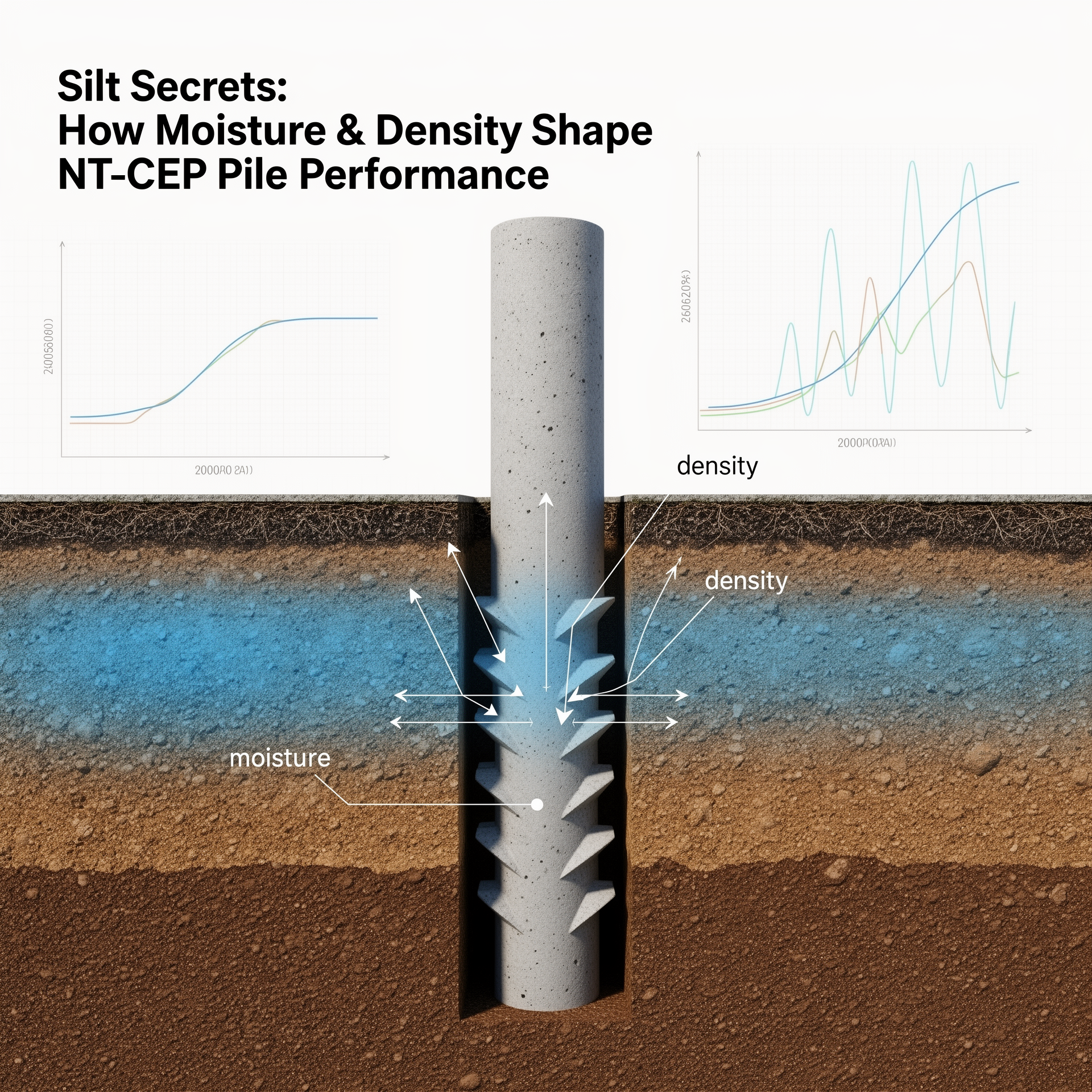
The New Type Concrete Expanded-Plate (NT-CEP) pile represents a significant evolution in foundation engineering, designed to maximize end-bearing and frictional resistance through strategically placed expanded plates along the shaft. While the geometry-driven capacity gains of such piles are well established, the interaction between the pile cap and the surrounding soil matrix remains a critical variable for design reliability. This study examines how silt subgrade properties—namely moisture content and compaction density—beneath the pile cap influence the overall bearing behavior of NT-CEP foundations, finding that the influence of silt properties on ultimate capacity is surprisingly limited within normal operating ranges.
Methodology and Experimental Setup
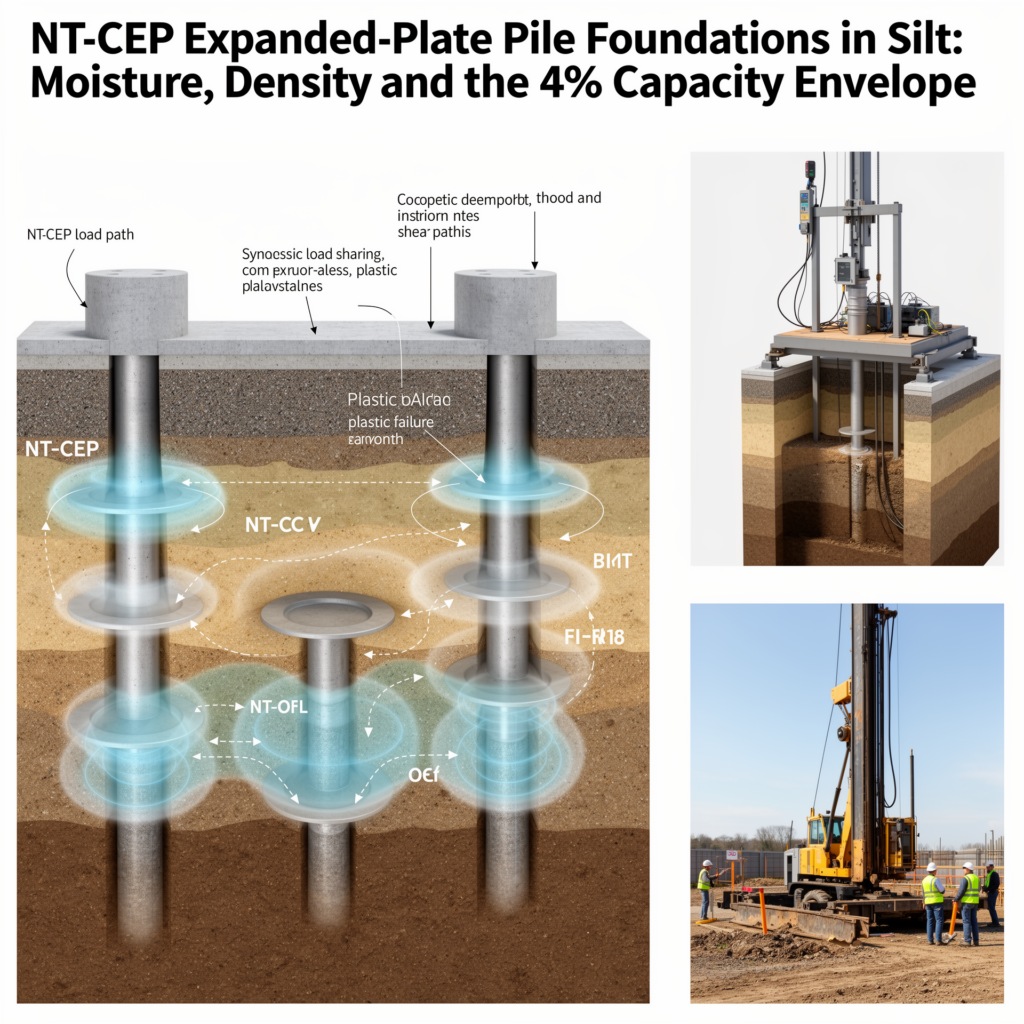
Scaled model tests were conducted using silt as the foundation medium. Two primary variables were systematically altered: moisture content (ranging from 12% to 16%) and dry density (corresponding to compaction degrees between 80% and 90%). The pile cap rested directly on the silt surface, while the expanded plates were embedded at predetermined depths. Static axial compression tests were performed to failure, allowing for the observation of load transfer mechanisms and failure propagation. For background on pile foundation testing standards, the ASTM D1143 standard for deep foundation load testing provides a widely adopted reference framework.
Key Findings: Synergistic Load Sharing and Failure Localization
The results demonstrate a robust and highly synergistic load-sharing mechanism between the pile cap and the expanded plates. Under axial loading, the pile cap mobilizes its bearing capacity early, while the expanded plates activate sequentially as settlement increases. This staged engagement prevents sudden capacity loss and promotes ductile failure behavior.
Plastic failure zones were observed to be highly localized, occurring predominantly directly beneath the pile cap and immediately below the lowermost expanded plate. This indicates that the intermediate shaft segments contribute primarily through friction, while the structural discontinuities—cap and plates—control ultimate limit states. This localization explains the relative insensitivity of ultimate compressive capacity to moderate changes in surrounding silt conditions. Readers interested in the role of soil physical parameters in similar geotechnical contexts may also find the companion study on silt physical properties under pile cap and NT-CEP pile bearing capacity a useful reference.
Influence of Moisture and Density: Less Than 4% Capacity Variance
Within the tested ranges (moisture 12–16%, compaction 80–90%), fluctuations in silt conditions induced less than a 4% change in ultimate compressive capacity. This variance is remarkably low compared to conventional pile systems, where moisture-induced softening can drastically reduce capacity. The resilience is attributed to the NT-CEP pile’s ability to redistribute load from the cap to the deeper expanded plates when the cap’s base contact deteriorates due to higher moisture or lower density. The expanded plates, being embedded in deeper and more consistent soil layers, act as a capacity buffer.
Recommended Operational Envelope
Based on the observed failure modes and capacity variance, a preliminary operational envelope is proposed for the scaled test conditions:
- Minimum Compaction Degree: 80% beneath the pile cap. Compaction below this threshold resulted in a disproportionate increase in cap settlement prior to plate activation, compromising serviceability limits.
- Critical Moisture Threshold: Below 14%. At moisture levels exceeding 14%, the silt beneath the cap exhibited reduced shear strength, causing localized punching failure. While the overall pile did not collapse, the margin of safety for the cap’s load share was significantly reduced.
Caveats: A Context-Specific Design Envelope
The authors emphasize that these thresholds are strictly benchmarked against the specific scaled model conditions, including a defined silt layer thickness and known pile stiffness. Direct universal application should be approached with caution for several reasons:
- Altered Stress Paths: Field-scale piles experience different stress histories and confinement levels, which can alter the failure mechanism.
- Elevated Groundwater Tables: The presence of a shallow water table would fundamentally change moisture migration and effective stress, potentially degrading cap contact well below the studied 16% moisture limit.
- Thixotropic Soft Clays: This study utilized silt, which has low plasticity. In thixotropic soft clays, remolding beneath the cap during driving or placement could lead to a temporary capacity loss not captured in these prepared soil tests.
Conclusion
NT-CEP pile foundations exhibit strong resilience to variations in silt moisture content and compaction density beneath the pile cap, with ultimate capacity variance under 4% within the tested limits. The localized plastic failure zones and synergistic load-sharing mechanism underpin this robustness. The recommended 80% minimum compaction and sub-14% moisture threshold provide a mechanics-driven baseline for design optimization. However, these values form a context-specific design envelope that requires calibration for full-scale field instrumentation and different soil types, particularly those with higher sensitivity or groundwater influence. Future work should focus on validating these thresholds under dynamic loading and long-term moisture cycles.
Lascia un commento