Buildings, Vol. 16, Pages 2722: Analysis of Energy-Saving Benefits of Tilted Façades in Different Climate Zones of China Based on Ladybug+Honeybee
Buildings doi: 10.3390/buildings16142722
Authors:
Xiaowan Han
Mengyuan Chen
Yu Gao
Li Peng
Ke He
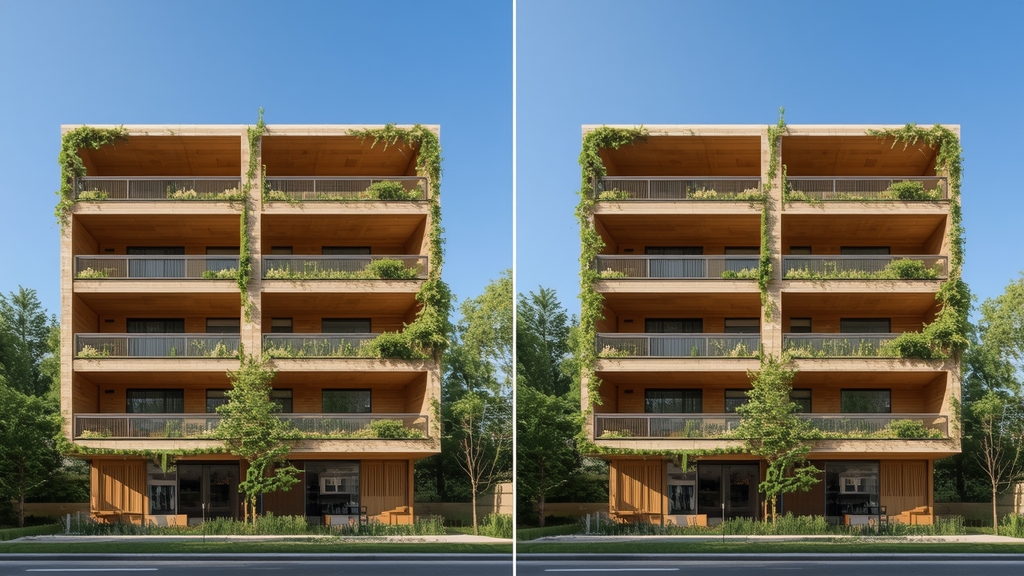
Current research on the energy performance of tilted façades is largely confined to specific climatic contexts or individual case studies, with limited systematic investigation of the energy-saving mechanisms across different climate zones in China. Comparative analyses based on Chinese building energy-efficiency standards remain particularly insufficient. This study investigates four representative Chinese cities corresponding to major climate zones—Harbin, Beijing, Shanghai, and Guangzhou—as research cases. A parametric office-building model was developed using the Ladybug–Honeybee simulation platform to evaluate annual cooling and heating energy consumption under different window-to-wall ratios (WWRs = 0.2, 0.4, and 0.6) and south-facing façade tilt angles ranging from 0° to 25°. A simplified thermal calculation model incorporating envelope heat transfer and solar heat gain was further combined with multiple linear regression analysis to examine the driving factors behind energy-consumption variations across climate zones. The results indicate that the energy-saving effectiveness of tilted façades decreases with decreasing latitude. During the cooling season, high-latitude cities exhibit the greatest reduction in cooling demand, with Harbin showing a maximum energy saving exceeding 16%, whereas Guangzhou shows a reduction of only approximately 5%. During the heating season, the tilted façades lead to a certain increase in energy consumption, but this adverse effect also diminishes with decreasing latitude. In terms of annual overall energy performance, Beijing, Shanghai, and Guangzhou achieve total energy savings of approximately 4–5%, while Harbin in the severe cold zone shows limited overall benefits. An analysis of solar radiation characteristics reveals that tilted façades substantially reduce direct solar radiation (by approximately 90%), thereby decreasing total solar heat gain, a trend that aligns closely with the reduction in cooling energy consumption. Moreover, higher window-to-wall ratios are associated with greater energy-saving effects, indicating that outwardly inclined façades are more suitable for office buildings with relatively large glazed areas. Overall, the energy-saving potential of tilted façades is primarily influenced by solar radiation conditions and the balance between cooling and heating demands. Such façades demonstrate good application value in regions with relatively balanced cooling and heating demands or cooling-dominated climates, whereas their application in severe cold regions requires more comprehensive evaluation. This study establishes an analytical framework for assessing the energy performance of tilted façades across different climate zones in China, providing theoretical support and design guidance for climate-adaptive design and form-based energy optimization.
Lascia un commento