
Masonry tunnels constructed between the late 19th and early 20th centuries form a critical part of our aging infrastructure. Despite their historical significance and continued use, systematically assessing their condition remains a formidable challenge. The inherent uncertainties of masonry—its heterogeneous material properties, complex stress distributions, and long-term degradation—make rapid yet reliable evaluation difficult. To address this gap, a Simplified Approach (SA) has been developed for quick structural analysis, adapting classic static techniques to evaluate the load-bearing capacity of historic tunnel linings efficiently.
Why Traditional Assessment Methods Fall Short
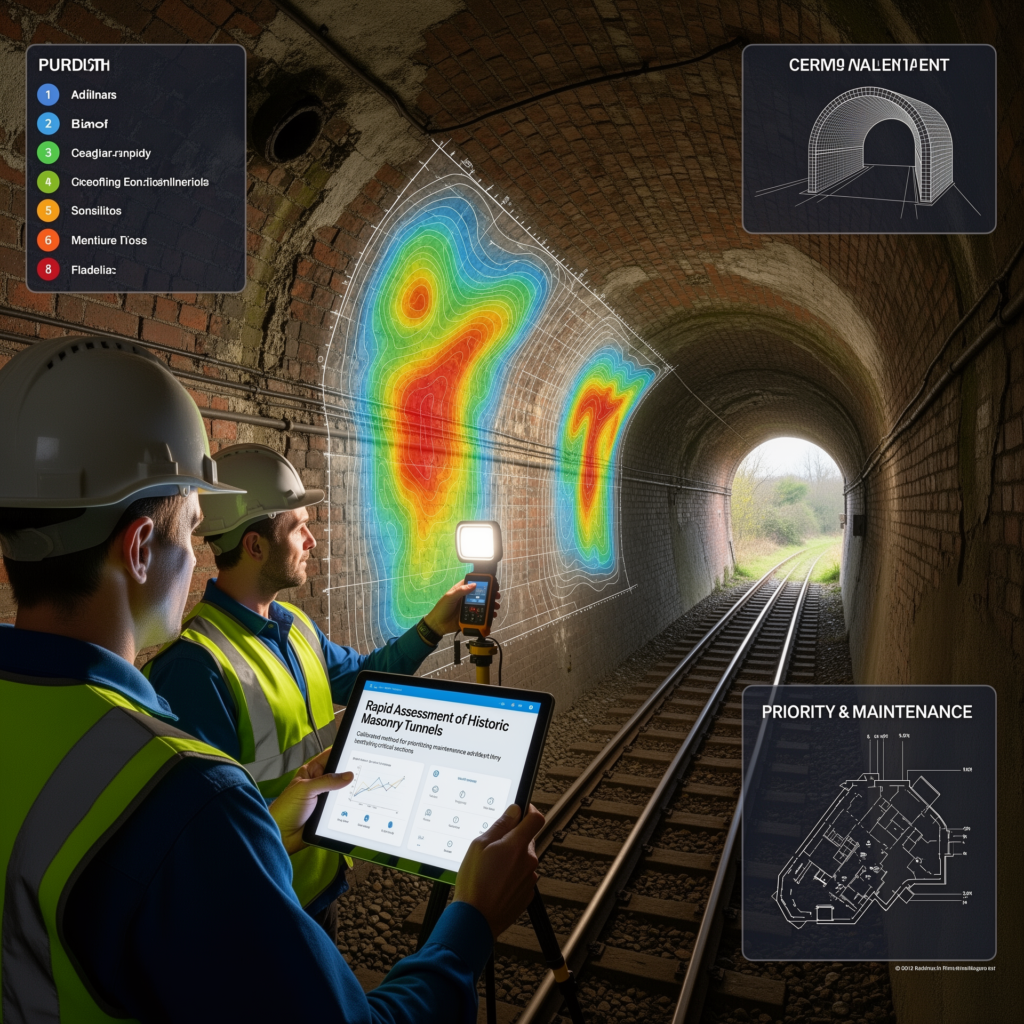
Full-scale numerical modeling is resource-intensive and impractical when applied to entire tunnel networks. Many aging tunnels lack detailed as-built documentation, and the variability of masonry as a structural material adds further complexity. Engineers often face a difficult choice between accepting unquantified risk and investing in costly, time-consuming investigations for every segment of an aging line. A scalable first-pass screening tool was therefore urgently needed.
The Simplified Approach: Core Principles
The SA method leverages principles of limit equilibrium and thrust line analysis, enabling engineers to compute the capacity of the lining with minimal computational effort. It is designed not to replace advanced methods but to serve as a first-pass screening tool for large networks of tunnels. In a recent application, the SA was calibrated against a well-documented case study where actual stress data were obtained from on-site measurements. Using these real-world readings, the approach was fine-tuned to produce detailed stress verification along the entire tunnel lining. The results demonstrated strong agreement between predicted and measured stresses, validating the SA as a practical, calibrated tool.
Thrust line analysis, a technique with roots in 19th-century engineering, determines whether the resultant compressive force at any cross-section remains within the kern of the masonry. When the thrust line stays inside the middle third of the section, no tensile stresses develop—a critical condition for a material that is weak in tension. By revisiting and calibrating these historical design methods against modern field data, researchers have shown that classical approaches retain strong predictive power when applied thoughtfully.
Identifying Critical Sections and Prioritizing Maintenance
One of the key strengths of the SA lies in its ability to identify critical sections that may be at risk. Once pinpointed, these areas can be subjected to more sophisticated, non-linear Finite Element Method (FEM) analyses for ultimate limit state verification. This targeted approach allows infrastructure managers to prioritize maintenance interventions and in-depth inspections without incurring the time and cost of full-scale numerical modeling for every tunnel segment. By combining the speed of the SA with the precision of advanced FEM, engineers can create an efficient, risk-based assessment workflow.
The workflow can be summarized in three stages:
- Network screening: Apply the SA to rank all tunnel sections by estimated stress demand, flagging those that exceed predefined thresholds.
- Targeted inspection: Concentrate visual surveys, crack mapping, and geotechnical investigations on flagged sections.
- Advanced verification: Run non-linear FEM models only for sections confirmed as structurally critical, minimizing overall analysis cost.
Calibration and Validation Against Field Data
The reliability of any simplified method depends on rigorous calibration. In the study underpinning this approach, stress readings collected from embedded sensors and flat-jack tests provided a ground-truth dataset. The SA predictions were iteratively adjusted until the modeled stress envelope closely matched measured values across multiple cross-sections. This calibration step is essential: without it, conservative assumptions can lead to unnecessary interventions, while unconservative ones create safety risks.
For further reading on thrust line methods and masonry arch assessment, the guidance published by the Construction Industry Research and Information Association (CIRIA) provides a recognized reference framework used across European infrastructure projects.
Integration with Broader Structural Assessment Practice
The SA does not operate in isolation. It fits naturally into the broader landscape of structural health monitoring and risk-based asset management. For example, similar simplified screening principles have been explored for other heritage structures. Readers interested in related comparative methods may also find value in the discussion of structural equivalence presented in the article on structural comparison and equivalent design methods for multi-span supports, which illustrates how simplified equivalence frameworks can inform complex engineering decisions across different structural typologies.
Practical Value for Infrastructure Managers
Ultimately, the Simplified Approach offers a pragmatic solution for the large-scale safety assessment of historical masonry tunnels. It embeds decades of engineering practice into a rapid evaluation framework that respects the unique behavior of masonry while providing actionable data for decision-makers. Key practical benefits include:
- Reduced analysis time compared to full FEM modeling
- Clear, auditable calculation steps rooted in established theory
- Compatibility with limited or incomplete as-built documentation
- A defensible, evidence-based basis for maintenance prioritization
As infrastructure continues to age across Europe and beyond, methods that balance analytical rigor with operational efficiency will be essential for extending service life, ensuring public safety, and preserving the engineering heritage embedded in these century-old structures.
Lascia un commento